CodeSignal runs AI skills simulations in its own platform, from 20 minute AI literacy checks to 90 minute technical ones. Lemonsignal gives candidates a real task in the AI tool they already use, and records how they worked, with a first read for your team to check.
Can candidates use AI in CodeSignal?
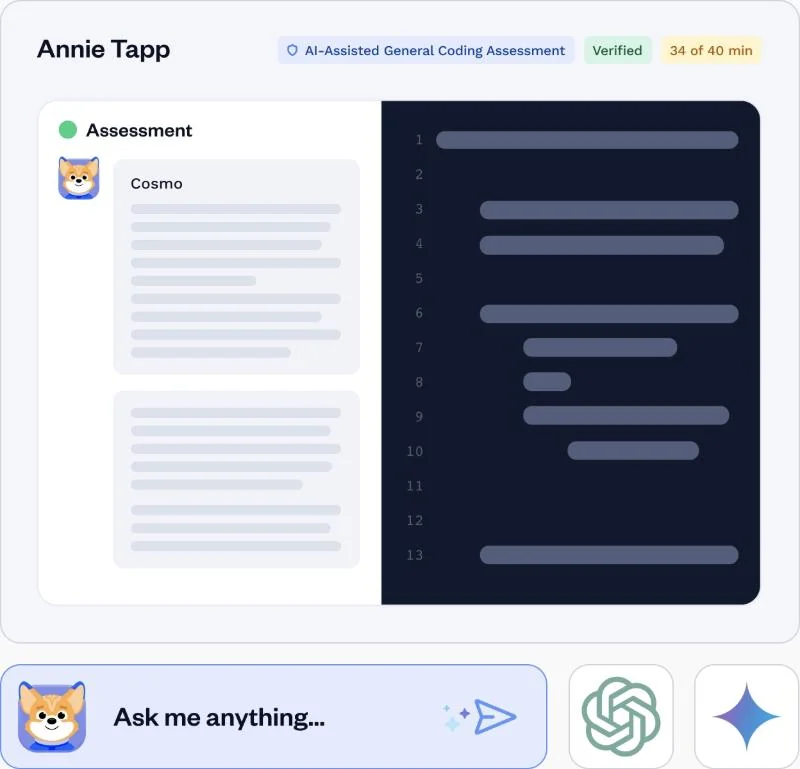
CodeSignalA CodeSignal AI-Assisted General Coding Assessment, with its AI assistant, Cosmo, beside the code. Image from codesignal.com/agentic-assessments, 14 Oct 2026.
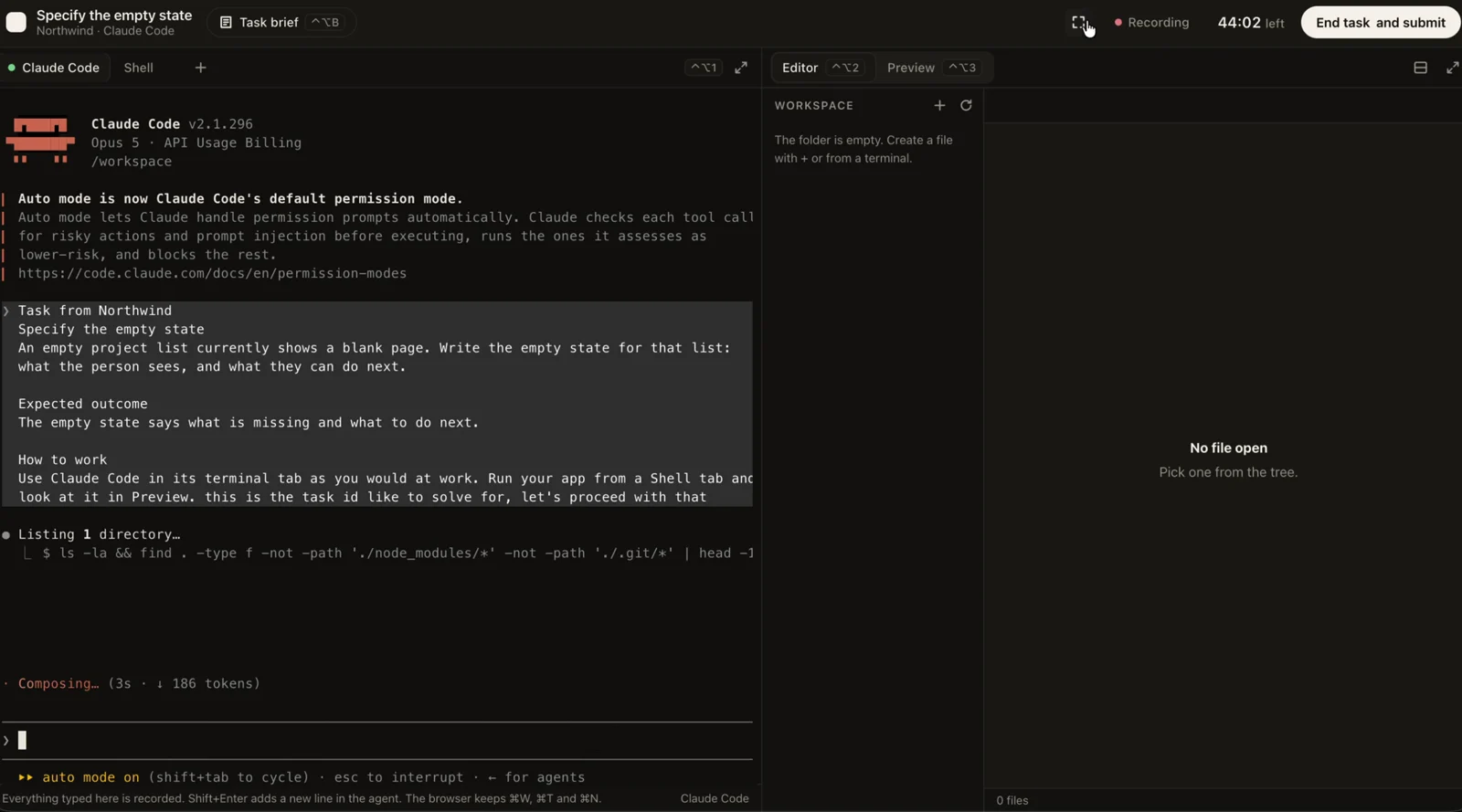
LemonsignalThe candidate works in Claude Code here, with the task brief, the time left and Recording on. They can use Codex, Claude Cowork or ChatGPT instead, in the browser or on their own computer.
CodeSignal vs Lemonsignal: side-by-side comparison
What CodeSignal says on its own site, checked 14 Oct 2026, next to Lemonsignal.
What candidates do
Simulations of real work: AI chat, prompt design, AI-assisted coding and scenario-based tasks. 20 to 30 minutes for AI literacy, 60 to 90 for technical. Also short interviews with an AI interviewer
A real task from the job, such as a bug to fix or a campaign to plan
Which AI tool
The AI inside CodeSignal’s platform, called Cosmo in the screen on their site; you choose which models power it. Their site does not say whether candidates can use their own tools
Their own: Claude Code, Codex, Claude Cowork or ChatGPT, on their own computer or in the browser
Who scores
Proficiency levels per AI skill. Their site says the assessments are designed by AI experts and validated by I-O psychologists, and does not say who scores them. In AI interviews the AI rates, tuned to match your reviewers, and people decide
Lemonsignal gives a first read, against a scoring sheet written before anyone takes the task. Your team watches the session, checks the read and decides
Roles
Technical AI roles, and AI skills for sales, marketing, HR and other teams
Engineering, product, design, marketing, data and finance
Watching for cheating
Proctoring, and cheating and fraud flags
Checks the person doing the task is the person you sent it to, and that the work matches the conversation
What you get back
Proficiency levels across AI skills. After an AI interview, a report with an overall score, a rating per skill and key insights, and the transcript
A recommendation, six AI skills and two or three job skills, each linked to the moment in the conversation it came from
CodeSignal vs Lemonsignal: what the hiring team gets back
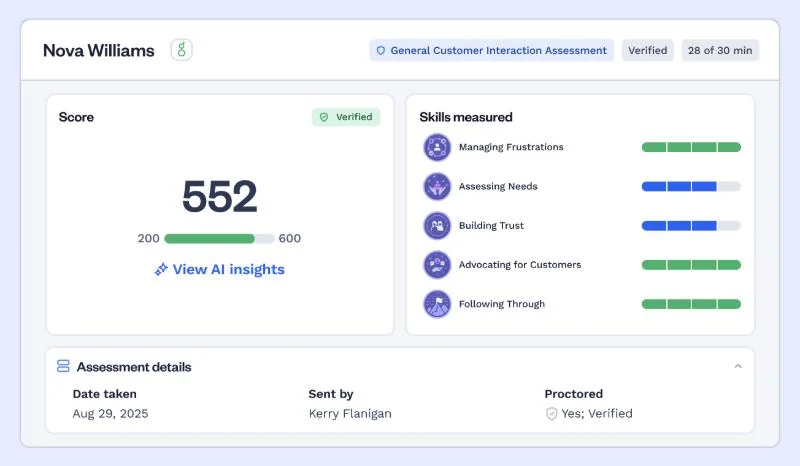
CodeSignalA CodeSignal candidate report: an overall score from 200 to 600, and a bar for each skill measured. Image from codesignal.com/ai-interviewer, 14 Oct 2026.
Lemonsignal. A result for an engineer who fixed a real bug with Claude Code. Every score links to the moment in the conversation it came from.
LemonsignalDana Okafor
Dana OkaforBackend engineer · Task: Fix a double charge · Claude Code · 2 h 40 min
Checked by Lemonsignal
89%Strong match
Found the cause before letting the AI write a fix.
Tested the AI’s fix instead of trusting it.
Fixed the second service with what she built for the first.
UnderstandStrongHad it reproduce the double charge, and followed one payment through the code before any fix.Turn 2
BriefSolidGave it the logs and the files that matter, and said what it must not change.Turn 4
CheckStrongRan the tests on the AI’s first fix and turned it down. Proved her own fix with a test.Turns 12, 19
CorrectStrongTold it why the first fix was wrong and where to look instead.Turn 13
Sign offSolidA small change with its test, and a note on what she did not test.
ReuseStrongSaved the steps as a skill and used it to fix the refunds service.
Skills for the job
Finding the root causeAbove the bar
Proving a fix with a testAbove the bar
Code others can maintainAt the bar
What she handed in, as she handed it in. Each mark is a skill from her result.
UnderstandStrongSign offSolid
Change noteCharge once per order, even when the gateway retries
Cause: after a gateway timeout, the retry created a second charge.
Fix: each charge carries a key for its order, so a retry returns the first charge instead of making a new one.
Test: a retry after a timeout now charges once. All 48 tests pass.
Not tested: partial captures, which we do not use yet.
CheckStrongReuseStrong
payments/charge.pyThe fix
def create_charge(order, card):
- return gateway.charge(order.total, card)
+ key = f"order-{order.id}"
+ return gateway.charge(order.total, card,
+ idempotency_key=key)
tests/test_charge.pyFails before the fix, passes after
+def test_retry_charges_once(gw, order, card):
+ gw.fail_next_with(Timeout)
+ create_charge(order, card)
+ create_charge(order, card) # the retry
+ assert gw.charges_for(order) == 1
refunds/refund.pyThe same fix in the refunds service
def create_refund(charge, amount):
- return gateway.refund(charge.id, amount)
+ key = f"refund-{charge.id}"
+ return gateway.refund(charge.id, amount,
+ idempotency_key=key)
Should you choose CodeSignal or Lemonsignal?
Choose CodeSignal if
You want short, standard AI checks for many candidates at once.
You want the same standard test across the whole company.
You also hire engineers with CodeSignal’s coding tests.
Choose Lemonsignal if
You want to see real work, not a simulation, for the roles that matter most.
You want candidates in their own AI tool and setup.
You want to watch the whole session yourself, and see the moment behind every score.
How is Lemonsignal different from CodeSignal’s AI assessments?
CodeSignal’s run inside its platform, and the short ones take 20 to 30 minutes. Lemonsignal gives one real task from the job, done in the candidate’s own AI tool. Lemonsignal records how they worked and gives a first read. Your team watches the session and decides.
Which is better for non-technical roles?
Both cover them. CodeSignal for a short, standard check at scale; Lemonsignal when you want to see someone do the real work of the role with AI.